Simple, quick, cheap and using my favourite freezer/ store cupboard ingredients- I haven't had much time for grocery shopping recently, so have been getting creative with my trusty old faithfuls- frozen spinach, sustainably caught frozen pollack, eggs and gram flour.
This took only minutes, most of which I spent catching up on emails and complying with various requests for information!
Serves two
1) defrost frozen pollack fillets and spinach in the microwave. Allow a maximum of 1 fillet per person and about 100-200g of frozen spinach each.
2) dice about 2 spring onions per person (or a small onion)
3) mash/ chop the defrosted fish and spinach into small pieces. Add the onion and spices to taste- I added a thumb sized piece of diced ginger, five spice, fresh black pepper and chilli flakes, but you could try fennel and garlic, or cumin, mustard seeds, turmeric and curry powder for a curried take.
4) Add half a cup of gram/ chick pea flour, slowly, stirring well. Continue adding until the water is absorbed and the mixture can be formed by hand into patties.
5) Pan fry 1cm/ 1/2 inch deep patties/ 7-10 cm diameter patties in a hot pan, until done (about 5 minutes each side).
n.b. you could also use left over fish of any sort in this recipe, and you could use less fish- just increase the amount of spinach and spring onion/ onion.
these are great cold so leftovers/ make extra for packed lunches.
make them smaller for an unusual canape or snack
Easy. Simple. Delicious
Showing posts with label waste busting recipes. Show all posts
Showing posts with label waste busting recipes. Show all posts
Wednesday, 28 September 2011

Thursday, 26 August 2010
Hum Hum Bean Soup
I needed to make space in the freezer the other day- I had made a much larger batch of fruit compote (rhubarb, pear and apple) than I had intended which needed freezing so that it didn't go off, so I took out the load of cooked beans that I had put in there before for similar reasons.
I had about a kilo of large white beans, boiled, once I had soaked them overnight out of their dry state (by far the cheapest way to buy beans is dried- you're not carting loads of water around) if I remember, with pepper, onions and dried red pepper flakes. Probably a sprinkling of chili flakes went in, maybe some herbs and a couple of bay leaves.
 Also found in the freezer- delicious home made chicken stock (don't bin anything until all the goodness has been taken from it!). I had cooked this up with some herbs, bayleaf and some wine that noone was going to drink.
Combining the beans and the stock in a pot with some water, some more unloved red wine, another onion and some of the canned tomatoes that I always have on hand, it came together into a lovely bean stew, which I blitzed to turn into a nourishing and delicious soup. I even gave some to my veg- detesting colleague (he had dated a vegan) and he was surprised to find himself enjoying it.
Now I need a way to use up 2l of fruit puree! Ideas, anyone?
I had about a kilo of large white beans, boiled, once I had soaked them overnight out of their dry state (by far the cheapest way to buy beans is dried- you're not carting loads of water around) if I remember, with pepper, onions and dried red pepper flakes. Probably a sprinkling of chili flakes went in, maybe some herbs and a couple of bay leaves.

Combining the beans and the stock in a pot with some water, some more unloved red wine, another onion and some of the canned tomatoes that I always have on hand, it came together into a lovely bean stew, which I blitzed to turn into a nourishing and delicious soup. I even gave some to my veg- detesting colleague (he had dated a vegan) and he was surprised to find himself enjoying it.
Now I need a way to use up 2l of fruit puree! Ideas, anyone?
Tuesday, 18 May 2010
The Secret to a Full Stomach, Empty Bin and Jingling Purse!

- Talk: First we discuss when we are going to be home, whether there will be guests and who is going to cook for the next few days. Communication is key!!
- Plan: Then we put down what we would like to eat depending on individual cooking capabilities and time at hand. We are not very creative during the week but at weekends we make an effort of trying out new things (which can be incorporated into our weekday routine) or dishes that take longer to prepare. What’s going on the eating plan depends on following:
o If there is a dish that needs a little of e.g. cream, then we’d make sure there is another recipe on the list that also needs a little cream.
o Allow for seasonality of ingredients
o Dishes with ingredients that don’t stay fresh for long are cooked earlier in the week
o The shopping list takes us up to Wednesday
Then we pop down the ingredients needed on a list.
- Shopping: We try to stick to the list! If there is a great offer on we think twice whether we really need it and when we could possibly eat it. Pre-packed fruit and veggies are avoided where possible. They are usually much more expensive per lb/Kg so we only buy what we really need and avoid the packaging.
- Mid-week stock take: As I said, we only plan until Wednesday and we take food stock on Tuesday or Wednesday. It happens very often that there are some leftovers, not everything has been used up as planned, we weren’t home as planned etc. So we look at the fridge for what’s left, is there something expiring soon and how these things can be combine with other ingredients to make another dish. I.e we talk again what we want to eat for the rest of the week.
It takes being organised but it’s really worth it. I hardly have to get rid of any food because I know what’s in the fridge and what I can make with it...
Monday, 8 March 2010
More Cauli for Your Lolly!
I was inspired to look at cauliflower. Cauliflowers are cheap and nutritious. I also have a great deal of memories of cauliflower cheese that I would rather forget- it wasn't so much that I didn't like it, but just that I need another then years before I eat if again! ...
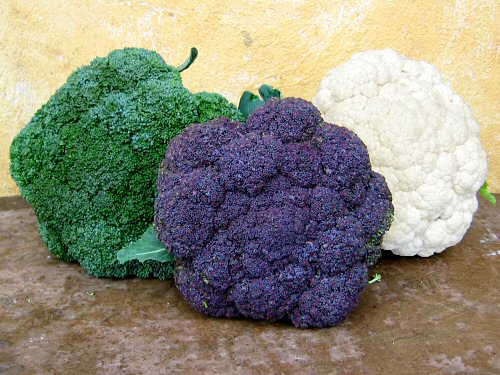
1) Make the most of your cauliflower!!
There is nothing wrong with that stalk! Once you have washed it and removed any nasty bits, you just have to chop it into small enough pieces so that it will cook in the same length of time as the florets : ) More cauli for your lolly!
2) Be creative
WHY OH WHY in the UK do we only eat boiled/ steamed cauli or cauliflower cheese? There are hundreds of ways to cook other vegetables!
Cauli can also be pureed as an alternative (and low carb version) of mash potato. Puree the boiled/ steamed cauli with a knob of butter and LOTS of black pepper. Even add some chives and paprika if you feel daring...
3) If you still want to make cauliflower cheese!
- Put LOTS of cheese in it
- Don't skimp on black pepper (or red pepper if you like that)
- Try adding garlic
- Add the greens- they are nutritious and delicious
- Toast it under the grill before you serve it
- Add a bit of leftover chopped bacon
- Why not add some spinach as a variation upon eggs florentine?
4) Another alternative: an idea from seaweed snack, a blog that I was reading: http://seaweedsnacks.blogspot.
Yesterday I coated cauliflower with olive oil, cumin, nutritional yeast, and then roasted it in the oven. Nutritional yeast is a yellow powder that is used by many vegetarians because of its high protein and B vitamin content. These tend to be in short supply in children's diets. Some contain B-12, but only if it is specially added.I topped mine with fresh coriander, but that is the adult version. And, this took less than 10 minutes to prepare!
Olive Oil and Cumin Roasted Cauliflower
oven 375F/ 195 C for 20 min.
1 head cauliflower broken into pieces
1-2 tbls olive oil
1 tbls cumin (or less if you are not a cumin fan)
pinch salt
1-2 tbls nutritional yeast
In a bowl, drizzle olive oil over cauliflower and mix well with you hands making sure each piece is coated. Add cumin, pinch salt and nutritional yeast. Mix with a spoon to coat. Be sure to really get all the yeast and spice on the bottom of the bowl coated on the cauliflower. Carefully spread on a cookie sheet and bake.
Top with a couple of pieces of fresh torn coriander.
Other ideas:
Serve this as a vegetable accompaniment
If you don't like Cumin, or don't have yeast, why not roast it with a drizzle of honey, or a drizzle of sesame oil?
Tuesday, 23 February 2010
Kedgeree: Spicy Delight from Leftover Rice

Kedgeree was one of my favourite childhood dishes, and is still something that I love to tuck into.
The dish became famous when Victorian British colonial types brought it back from India as a breakfast dish, but it has been argued that it originated in Scotland, got adapted in the subcontinent, and returned in a spicier incarnation.
In hot, pre-refridgeration India, fish was served at breakfast time, whilst it was still fresh. This is too hearty a breakfast dish for me, but an excellent dinner or possibly brunch.
The recipe usually calls for curry powder, cooked rice, flaked smoked haddock, chopped boiled egg and perhaps some parsley or coriander garnish, but once you have the principle it is very adaptable.
Step by step:
- The cooked rice (you might want to warm it first in the microwave so that you don't have to fry it for a long time, or warm it through with hot water)
- Put some oil in a large frying pan or wok, and add curry powder, chili powder or other spices. If you wanted to add sauteed onions, now is the time to cook them.
- Before adding the warmed rice, turn the chopped (quartered or sixteenthed) boiled eggs and flaked smoked haddock (you could substitute this for bacon or cold, chopped meat) in the hot oil and spices so that they are warmed through or cooked).
- Add the rice, mixed it thoroughly until it is piping hot in the oil and spices
photo with thanks to crisphin
Brilliant Banana Cake

Prep time: ~15 minutes
You need:
Butter- 125g
Sugar-3/4 cup
1 egg
ripe, mashed bananas-2
1 1/2 cups self raising flour
1/4 cup of milk
you could also add a complementary flavour such as vanilla, poppy seeds or think about substituting some of the sugar with a brown or muscavado sugar.
To make:
Take the sugar and butter (and vanilla if you are using) and melt in a saucepan. Add the bananas and mix well. Beat the egg and then mix that into the mixture in the pan, followed by the flour. When the mixture is well mixed slowly add the milk and mix gently. Put the mixture into a cake tin and bake for around 4o mins at 170 degrees/ Gas mark 3-4.
Delicious :)
To serve:
Excellent as a cake, it is also wonderful hot with cream or vanilla icecream as a warming pudding.
===
Don't want to waste banana skins? Make them into fertilizer
photo with thanks to KCanard
Egg Substitutions

How often do recipes call for something that you almost have?
- When making custards or salad dressings you can substitute two egg yolks for one whole egg.
- In dough containing yeast or cookie dough substitute two egg yolks for one egg, and add a tea spoon of water.
- If you are baking and find yourself one egg down (but only one! This won't work for more than that!) substitute two tablespoons of mayonnaise
Milk it!
I remember a time when I was about 8. We were on holiday, staying on a boat, with an ice box and no fridge. It was the summer, and naturally enough the milk on our cereal wasn't quite as fresh as we were used to. We moaned.
But actually, milk which is "on the turn" is not bad for you, neither rancid or mouldy, and could be employed in other ways even if it not to your taste splashed into tea or liberally poured over cornflakes. In times passed curds were an important part of Irish food culture.
But actually, milk which is "on the turn" is not bad for you, neither rancid or mouldy, and could be employed in other ways even if it not to your taste splashed into tea or liberally poured over cornflakes. In times passed curds were an important part of Irish food culture.
- Check that it is actually "off". It sounds stupid, but as kids we were convinced that anything passed its sell-by date was bad. I have friends who are still like this. It is easy to tell with milk. If it smells fine, then it is fine, regardless of what the packet says. And you will know if it doesn't smell good!
- If it is a little sour, it can still be used for baking- cakes, biscuits and so on.
- Make cream cheese. You can leave it go sour (make sure it is still in its container or covered), cook until it boils wrap the remaining lumpy bits in a cloth (cheese cloth or muslim) and hang. The liquid needs to drain out but you will be left with delicious homemade fresh cheese, which you could mix with fresh herbs, finely chopped onions or garlic, or pretty much anything you fancy. For a different flavour you could also try adding white vinegar or lemon juice to the milk when it is cooling, which will help it to curdle.
- Another version of this is the Indian fresh cheese, paneer, which is pressed after the curds and whey have been separated. Once made, you could also preserve this cheese in olive oil.
- Make yoghurt. You need a bit of yoghurt to start with "live and active cultures" in it. Bring the milk to a boil. When it starts to get foamy on top, remove from the heat until it cools to around 46 degrees C (115 F) or until you can hold your finger in it without it burning. Put a couple of spoonfuls of yogurt in a jug and blend it together with some of the warm milk. Pour the mixture back into the pot of warmed milk and stir. Pour the warmed milk into clean containers (large glass bottles or washed and dried 4 pint milk cartons could be good), put the lids on, cover with the containers with a towel, and put them in a cool, dry, undrafty place over night. Wake up to fresh yoghurt!
Traditional Irish Curd Cake

Traditionally this would have had a pastry crust, but in the interests of health, and speed, you might want to just bake the mixture in an oven-proof dish, or you could experiment with using broken digestive or ginger biscuits as an alternative base.
Lemon and Vanilla Curd Cake
You will need:
- 175g/ 6oz sweet shortcrust pastry or a pre-bought pastry case (if using)
- 50g/2oz caster sugar (+ 1 tbsp for the topping)
- vanilla essence or extract
- half a lemon (juice and grated rind)
- 1 egg (beaten)
- 2 egg yolks
- 225g/ 8oz cottage cheese (homemade or bought)
- 2 heaped tablespoons of plain flour
- 1tbsp melted butter
- Preheat oven to gas mark 4/ 180°C/ 350°F
- If you are using pastry: warm a baking sheet and grease a loose-bottomed flan tin. Roll out the shortcrust pastry until thin, then line the flan tin with the dough, trimming off any excess. Chill pastry case (that you have made or bought) in the fridge.
- If you are not using pastry put your broken biscuits into the bottom of a dish for a more informal but equally delicious family pudding. Ignore this step if you simply want a set curd putting without pastry or biscuit.
- Sieve the cottage cheese, or your freshly make paneer/ cream cheese.
- Cream together until fluffy the butter and sugar, before beating in the egg yolks, 1 heaped tbspn flour, lemon zest, lemon juice and the cheese. Mix well.
- Spoon the mixture into the pastry case/ onto the biscuit base or put into the dish on its own.
- Mix together together the beaten egg, one tbspn flour, spoon of caster sugar, 1tbsp melted butter sugar (you might also want to add further lemon zest). Spatula evenly over the curd filling.
- If you are using pastry in a flan tin, pop it onto the warmed baking sheet. Otherwise just put your dish into the oven and bake for around an hour. When it is done the top shoul dbe a little brown and a bit firm.
- Best served cool, not chilled. You could dust with sugar or garnish with grated lemon rind.
Beacon Bruithe- Irish Baked Mushrooms

Oh, the olden days, when you could pick mushrooms in the fields...
But in the modern day you can pick them up cheaply in the supermarket and make a filling meal or breakfast for not too much. This recipe also allows you to use up stale bread and when it calls for sausagemeat, gives you the perfect opportunity to use up the last couple of sausages in the fridge (just take the meat out of the skins).
Ingredients
15 big mushrooms (or 1kg)
4 oz diced onions
4 oz bread crumbs (use up your stale bread or savoury scones- whole wheat is best)
4 oz sausage meat (you could use up the last few sausages)
1 tspn herbs (sage is good, but you could try chives, thyme, marjoram, garlic, parmesan, leftover cheese)
salt and black pepper to taste
butter or olive oil
Directions
- Wash and peel the mushrooms. You can use the stalks- just make sure they are washed and cut off the dry end.
- Set the oven to moderate.
- Brush mushrooms with melted butter, or olive oil for healthier and quicker option
- saute the onions in butter or oil. When they are translucent mix them with the breadcrumbs, the sausagemeat, herbs, salt and pepper.
- Put the mushrooms in an oven proof dish, if you are using the stalks (we don't like waste around here!) also put them in the dish. Put a little water (~5oml) in the bottom and place the mixture into the mushrooms.
- Bake for 15-2o mins
Mediterranean Inspired Cheese Preserved in Olive Oil
Olive oil- golden goodness. We have heard it said hundreds of times, but have you ever thought of it as a preservative? It keeps out air and the bacteria that lurk in it
It has long been used as a traditional preservative in Mediterranean countries, and you can often find Greek feta or halloumi, or the Spanish sheep's milk cheese, Manchega, preserved in olive oil.
If have bought lots of cheese which you are not sure how to get through, want to make an exciting tapas or are just feeling creative, why not try preserving cheese in olive oil?
Before you preserve the cheese:
bottom photo with thanks to Neven Mrgan
It has long been used as a traditional preservative in Mediterranean countries, and you can often find Greek feta or halloumi, or the Spanish sheep's milk cheese, Manchega, preserved in olive oil.
If have bought lots of cheese which you are not sure how to get through, want to make an exciting tapas or are just feeling creative, why not try preserving cheese in olive oil?
Before you preserve the cheese:
- It must be clean and dry. Use paper towels and cut off anything you have doubts about. Make sure your hand are clean before you touch it.
- The jam jars or kilner jars you use must be completely clean and dry and sterilized.
- Cut the cheese into small cubes and place in the jar
- Cover the cheese with olive oil, although not right up to top of the jar.
 Extra virgin olive oil will give you the best flavour.
 - You might want to add some flavours to the oil, such as garlic cloves, sprigs of rosemary, chili peppers, oregano, thyme and basil. They should be dry.
- Once you open it, remove any sprigs of herbs- once exposed to the air they might deteriorate and the oil will already have taken on the their flavour.
- Don't waste the oil! Drizzle it over salads, fresh bread or as an accent on top of a bowl of home-made soup.

bottom photo with thanks to Neven Mrgan
Carrot Curry

I learned how to make carrot curry from a Sri Lankan Tamil friend. It quickly became a favourite of mine, and went down a storm with guests. Her recipe was for a vegetable accompaniment- something to go with rice, lentils (dal) and a meat curry. This recipe has the potential to stray quite far from the authenticity of the original (apologies), but with tasty results. You could also use this method with grated potato, parsnips, swedes and other root veg, or with boiled/ steamed broccoli, cauliflower etc
Basic recipe:
- one small onion, diced
- 6 grated carrots
- garlic clove
- cumin (jeera)
- mustard seeds
- curry powder (not garam masala- madras would be good)
- garlic
- oil
- Put the oil (groundnut oil is best, but I usually use olive oil as it is at hand and it is still delicious) into a large frying pan. Add a teaspoon of mustard seeds and the same of cumin seeds. Let them cook for around a minute, but not until black.
- Add the diced onion and sweat/fry them until transparent. Sometimes I like the onion crispier- it doesn't matter. With this curry it is never quite the same twice as there is so much room for experimentation.
- When the onion has cooked, add the grated carrot and diced garlic. You must remember to stir often. It will take around 15-20 minutes on a medium heat to cook.
- Authentically, this curry should be quite al dente but I like mine softer and possibly a bit crispy- for this to happen you will have to wait until the water (that will come out of the carrots) evaporates.
- Towards the end add some curry powder (to taste). It always tastes better cooked with some oil or butter- add a drop of oil and add the curry powder on top, allowing it to sizzle before stirring it in. Add salt to bring out the flavour!
- Also delicious if you add the juice from a thumb-sized piece of fresh garlic towards the end.
- Sometimes I like this as a main course on its own. It is wonderfully colourful. If I was doing this I would usually toast some peanuts (raw, with shells) in another frying pan and mix at the end. This is really simple and very tasty, and adds protein and substance.
- For a lazy, after work version I might stir in a couple of spoons of peanut butter. This is also great if you are microwaving leftover curry the next day or for a packed lunch. Tasty with leftover rice, or even in a tortilla/ chapati or naan.
- Use up left over carrots. The original uses grated carrots, but why not use leftovers instead? It would also be great with leftover broccoli, cauliflower, potatoes, and other root veg
- For a wetter curry, add some coconut milk (100-150ml) when the carrots are almost cooked. You could even just add cows' milk.
Subscribe to:
Posts (Atom)